



(2020) Using the Neurolinguistic Approach (NLA) and the boucle de la littératie to enhance oral production, reading and writing in Late French Immersion
- Introduction
- Question 1: How do students develop language skills in Late French Immersion?
- Question 2: What specific strategies are helpful for integrating language and content in French Immersion?
- Question 3: What is the Neurolinguistic Approach and how does it encourage the integration of oral, reading and writing through the boucle de la littératie?
- Question 4: Can elements of the NLA support the principles and goals of Late FI?
- Implications for classroom practice
- Conclusion
- Références/References
Introduction
In Late French Immersion (LFI), Grade 7-9 students with little or no previous exposure to French learn required curricular content entirely in French. One of the great challenges in LFI is to provide opportunities for students to develop ever-stronger comprehension and production skills to allow them to master the content. The Neurolinguistic Approach (NLA) is an approach for teaching French as a Second Language that uses strategies to develop students’ comprehension and production gradually and through scaffolding of their competencies by implementing the literacy loop (boucle de la littératie). The strategies of the NLA can be used effectively in Late French Immersion to support the development of students’ language skills as they work the required content.
Question 1: How do students develop language skills in Late French Immersion?
Language in French Immersion (FI) is taught by providing content-based input in French as a second language (L2) as required by the provincial curricula (Programs of Studies). Students begin Late FI (LFI) usually in Grade 7, with little or no prior exposure to French. They are immediately immersed in content learning in French and are expected to adjust to the language input quickly and to manipulate language as they learn content. But “…how can learners fully participate in oral interaction, as a means to engage with both language and content while developing their production abilities, if the language of communication is one that they are still learning and thus know only partially?” (Tedick & Lyster 2020, p.130).
FI teachers address the development of specific L2 language skills in various ways (Lyster 2007), but often face challenges because of the already heavy content curriculum and inconsistent support for integrating language and content. Young adolescents are well-equipped to learn language quickly through content thanks to their cognitive maturity; they can leverage their experience as learners to develop strategies to cope with the challenges of learning content in a new language. Yet support is necessary to ensure that they achieve success. Tedick and Lyster (2020) suggest that scaffolding is a key tool to support students in their learning. This scaffolding can be implemented in three ways: (1) verbal scaffolding, that is, linguistic redundancy while still focusing on moving forward; (2) procedural scaffolding for comprehension (activity frames and routines); and (3) instructional scaffolding for comprehension, such as graphic organizers and resources to support comprehension (Tedick & Lyster 2020, pp. 131-132).
Question 2: What specific strategies are helpful for integrating language and content in French Immersion?
Lyster (2007; 2016) underlines the value of using a counterbalanced approach in FI, that is, “a principled means for systematically integrating content-based and form-focused instructional options.” (2007, pp 3-4). Planning lessons that require students to focus on both content and language provides at the same time authentic context for the language and the necessary language support to understand and manipulate that content. Teachers should approach lesson planning with thoughtful, careful consideration of which L2 language elements will be needed by FI students to understand and manipulate the new content, and then creating objectives to ensure that language is attended to (Cammarata & Tedick 2012). This can be accomplished by using backwards design, that is, starting the design process by envisioning the final project or task, and carefully scaffolding the lessons leading up to that task to build the competencies necessary to complete it. Making the counterbalance of language and content a priority in planning will ensure that language objectives will support the content and that the content will provide a context to make the language accessible.
Question 3: What is the Neurolinguistic Approach and how does it encourage the integration of oral, reading and writing through the boucle de la littératie?
A key element of the Neurolinguistic Approach to language learning (Paradis 2004; Netten & Germain 2012) is to build students’ internal grammar (that is, their implicit knowledge of the language) by providing them with carefully planned, authentic models of language based on pertinent and age-appropriate themes, which they will gradually manipulate to ultimately express their own meaning. Another key driver of the approach is the literacy loop (boucle de la littératie) which provides a framework predicated on the notion that oral development should come first to allow students to develop an “internal grammar” as they listen to L2 input and respond to modelled language by gradually personalizing the ever-more-complex modelled sentences to express their own meaning.
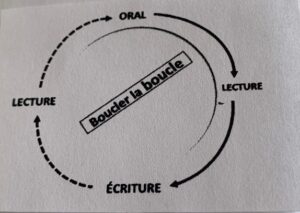 (Germain, 2017, p. 37)
The strategies used by teachers of beginning French as a Second Language students who use the NLA follow several principles: teachers and students use only the target language, they use only complete sentences, and students may ask “Comment dit-on?” for single-word support. Teachers provide oral modelling of carefully selected sentences, with a view to providing ever-richer samples of language. The approach follows a project-based pedagogy, which implies careful planning to provide students with the language to interact around specific grade-appropriate themes.
Oral language is developed following careful planning by the teacher to model specific oral language structures and thematic lexical items and providing opportunities to re-use the language ensuring that students can express their meaning orally before moving on to reading and then to writing.
The reading phase is carefully structured so that students can see in print words that they know how to say, and sentence structures that they are already able to produce orally. The teacher takes time during the reading phase to highlight challenging sound-letter correspondences, as well as chosen grammatical features that are salient in the written form, to prepare students for writing. The writing phase follows, with the teacher taking time to model how to write the target piece, inviting students to contribute, again using their oral language as the base.
To close the loop, students “publish” their writing, by sharing it (reading aloud) with a partner, with their group, with the class or with a wider group, with the intention of generating oral language to discuss the written piece. The reading and writing phases follow accepted literacy practices of prediction, modelling and scaffolding. (Germain, 2017)
Question 4: Can elements of the NLA support the principles and goals of Late FI?
Recent research (Mueller 2018) has shown that teachers can benefit from using the strategies of the NLA to enhance language learning in FI, especially at the beginning of Early FI and as students begin Late FI when they have little or no previous exposure to French and need to develop skills to manipulate language comprehension and production quickly.
Lyster (2007, 2016) reminds us that FI students need to produce output in order to process the input that they are receiving. It is crucial, therefore, to create the conditions for students to produce as much output as possible, so planning needs to allow students to interact with the teacher and with each other using oral language. As the NLA suggests, the use of complete sentences will allow for the development of students’ internal grammar, allowing them to hear and re-use authentic and accurate models of language.
Tedick and Lyster (2020) suggest that scaffolding can allow LFI students to engage with content as they learn the language by drawing on contextual clues and prior knowledge. Using the boucle de la littératie can allow teachers to plan opportunities to scaffold language from oral through reading and to the writing phase, thereby reinforcing content-based language that students will need. Closing the loop (boucler la boucle) by returning to oral language to discuss the written production will reinforce the language yet again. Using an approach like NLA in LFI pushes teachers to think carefully about the input they provide: they should provide a model to students of complete sentences to illustrate syntax, as well as content-appropriate lexical items and structures that students will need in order to manipulate curricular content. Insisting on the exclusive use of the target language and of complete sentences will encourage students to pay attention to syntax and structure as they build their “internal grammar” (Netten & Germain 2012; Germain 2017). Late French Immersion teachers can access the strategies of the NLA to provide planned and structured modelling to ensure that students will build up a base that will allow them to access content in a way that will ultimately reinforce their language skills.
Implications for classroom practice:
According to Tedick and Lyster (2020), FI teachers should plan with scaffolding in mind to allow their students to maximize language within the content. They discuss three types of scaffolding that can support comprehension and production during content and language integration: verbal scaffolding (redundancy in input, questioning to encourage production), procedural scaffolding (predicable activities and routines and a variety of ways to use language), and instructional scaffolding (graphic organizers multimedia resources to support learning) (pp. 131-134). One way that Late French Immersion teachers can ensure that content-linked language is scaffolded is through the use of the strategies of the NLA, specifically, the boucle de la littératie. Using the boucle as a framework allows LFI teachers to introduce language orally, provide students a variety of opportunities to use the oral language, reinforce this oral language through reading, and then through writing. In this way, teachers can plan to ensure that students’ language skills can be tied to content and reinforced in a gradual and deliberate way.
Oral:
Scaffolding will occur as teachers push students to use the new structures and lexical items in their oral language, encouraging them to develop ever-richer and more complex sentences to work the content. The use of complete sentences by teachers and students is crucial to reinforce students’ internal grammar, that is, their understanding of how the language is constructed. In a LFI science lesson about climate change, for example, the teacher can begin by opening a discussion, asking questions to model the use of important terms, and requiring students to respond to questions using the same structures and lexical items. Activities such as small group discussion, narrating video clips or creating a podcast sharing concerns about climate change can allow students to manipulate the concepts and practice the content-related language. Mastering the oral language related to the content will support the move into reading.
Reading:
Teachers should carefully select reading texts that will re-use the same language that students can produce orally, while reinforcing the academic language and content that are being worked. During the reading phase, teachers can work with students to focus on explicit grammar, that is, those elements of the language that are salient in the written form. An excerpt from instructional materials that has been carefully chosen to illustrate the same lexical items and content-related language as were practiced orally can be used to deepen students’ use of the language. The teacher can create activities that will allow students to interact with the reading passage, such as providing opinions and crafting questions for their peers.
Writing:
When teachers move through the loop to the writing phase, students have more success writing because they are comfortable with what complete sentences look like, thanks to their oral practice and the scaffolded reading. Their spelling and grammar should contain fewer errors, due to the work that was done during the reading phase, noticing sound/letter correspondences and grammatical particularities.
Project-based Pedagogy:
Teachers who use a project-based pedagogy, such as the framework used with the NLA, design their lessons using the literacy loop (and smaller mini-loops within) with a view to developing the language skills to allow students to accomplish a final project. In Late French Immersion, teachers can follow a similar model: focus on the final outcomes using backwards design, developing the language necessary to accomplish the final task (and interim tasks) by using the literacy loop to scaffold language according to the oral-reading-writing-oral sequence. Planning with a view to providing the language needed to support content learning will be crucial to prepare students to progress through the curricular requirements of LFI while developing their French language skills.
Conclusion
The strategies that underpin the Neurolinguistic Approach have been successful in contributing to the development of oral language for students studying French in other contexts. Research has indicated that French Immersion teachers can benefit from what we have learned about using the literacy loop (oral-reading-writing-oral) as a way to scaffold language. In particular, the literacy loop can support the development of academic language and content-related language for Late French Immersion students. Beginning with oral until students are comfortable with the language before moving to reading and writing will create a solid base for students as they learn and begin to manipulate content in the Late French Immersion context.
Références/References:
Cammarata, L & Tedick, D. (2012). Balancing content and language in instruction: The experience of immersion teachers. Modern Language Journal, 96, 2, 251-269.
Dressler, R. & Mueller, K. (2020). Strategies for purposeful oral language use in the second language classroom. Réflexions (CASLT), Fall 2020 (forthcoming).
Germain, C. (2017). L’approche neurolinguistique (ANL) : foire aux questions. Longueuil : Myosotis.
Lyster. R. (2007). Learning and teaching languages through content: A counterbalanced approach. Amsterdam: John Benjamins.
Lyster, R. (2016). Vers une approche intégrée en immersion. Anjou, Les éditions CEC.
Lyster, R. (2018). Content-based language teaching. New York: Routledge.
Mueller, K. (2018). Investigating the Intensive French Approach: A report on the 2017-2018 phase and final summary report on the longitudinal study for the Calgary Board of Education. Unpublished.
Netten, J. & Germain, C. (2012). A new paradigm for the learning of a second or foreign language: The neurolinguistic approach. Neuroeducation, 1(1), 85-114.
Paradis, M. (2004). A neurolinguistic theory of bilingualism. Amsterdam: John Benjamins.
Tedick, D.J. & Cammarata, L. (2012). Content and language integration in K-12 contexts: Student outcomes, teacher practices and stakeholder perspectives. Foreign Language Annals, 45,1, s28-s53.
Tedick, D. & Lyster, R., 2020. Scaffolding language development in immersion and dual language classrooms. London: Routledge.
