Aller au contenu

Ressources

TRIER PAR :  Ressources recommandées
(2026) Recent studies provide evidence supporting inclusion and diversity within French immersion programs.

(2026) Recent studies provide evidence supporting inclusion and diversity within French immersion programs.

School boards across Canada actively strive to welcome diverse students into French immersion programs (e.g., OCDSB, 2025). Still, gaps exist in equitable access to French immersion (Barrett DeWiele & Edgerton, 2020; Kunnas, 2024). For example, students who are considered at risk for academic difficulties, such as students with additional learning needs and those from multilingual homes, are less likely to register, and to stay registered, in French immersion (Kay-Raining Bird et al., 2021).
Consulter
(2026) Supporting French Immersion Students with Reading Difficulties and Reading Disabilities

(2026) Supporting French Immersion Students with Reading Difficulties and Reading Disabilities

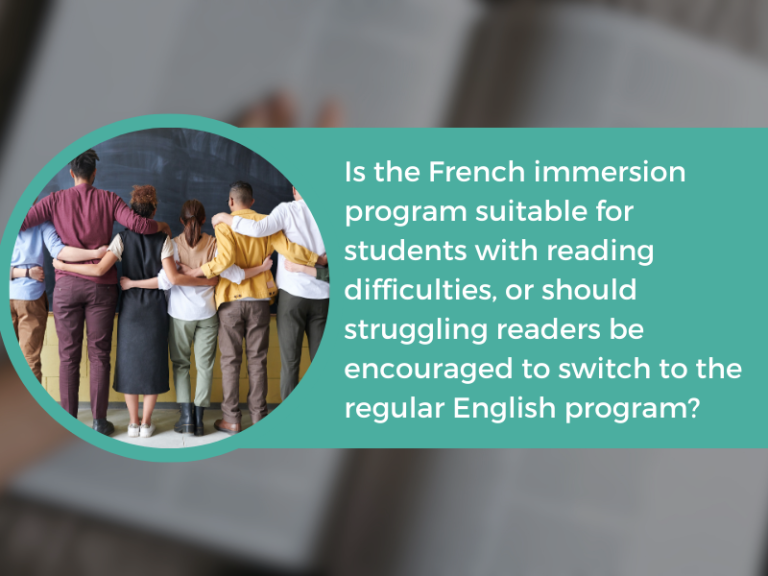
Due to its popularity, the FI student population has become increasingly diverse (Bourgoin, 2014; Garrett & Mady, 2024). Today’s FI classrooms often include students with varied learning needs, including children who struggle to learn to read. Despite considerable research evidence that has established the suitability of FI for struggling readers (Genesee, 2007; Genesee & Erdos, 2019; Grosjean, 2019; Wise, D’Angelo, & Chen, 2016; Wise & Chen, 2015), some people believe that dual-language educational programs like FI are not suitable for students who have difficulties with reading acquisition or those with diagnosed reading disabilities (e.g., dyslexia). It is generally thought that learning two languages simultaneously will exacerbate their learning challenges (Genesee, 2015).

Consulter
Pourquoi s’intéresser à l’identité bilingue en immersion?

Pourquoi s’intéresser à l’identité bilingue en immersion?

Une des raisons pour l’attrition de nos élèves et de nos enseignant·es en immersion est que l’on s’est beaucoup concentré sur le développement des connaissances langagières et on a parfois négligé de valoriser l’identité de ces personnes bilingues. Ce que cela veut dire est qu’il faut appuyer le développement de dispositions et d’attitudes positives qui … Continued

Consulter
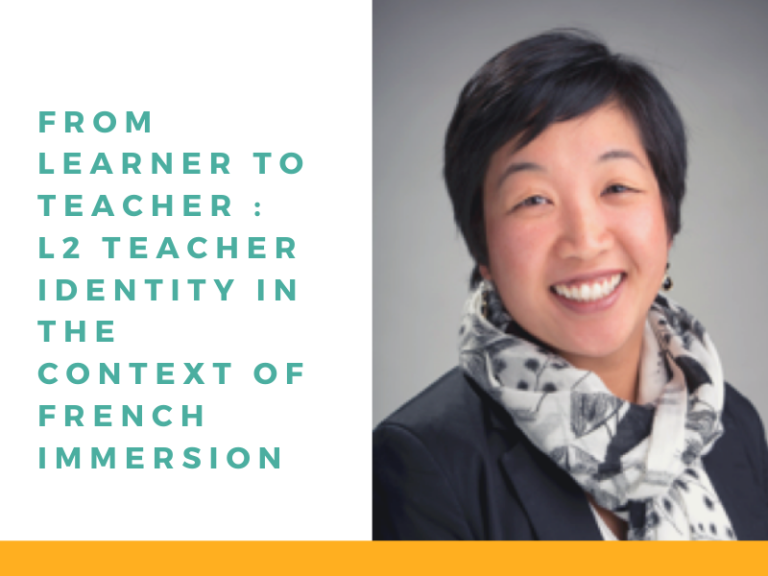
(2020) D’apprenant à enseignant : L’identité L2 des enseignants en contexte d’immersion française / From learner to teacher : L2 teacher identity in the context of French Immersion

(2020) D’apprenant à enseignant : L’identité L2 des enseignants en contexte d’immersion française / From learner to teacher : L2 teacher identity in the context of French Immersion

As French Immersion (FI) grows in popularity, an increasing number of teachers in this program are themselves graduates of the same program. While this signals a long term success of the language learning experiment that began in 1965, there are also research studies which point out the issue of attrition in teachers who work in their second language (L2) and the connection with their L2 identity (Masson, Larson, Desgroseilliers, Carr & Lapkin, 2019; Parks, 2017)

Consulter
(2025) Supporting students with learning difficulties in French immersion

(2025) Supporting students with learning difficulties in French immersion

The French immersion program was created to be inclusive of all learners as determined at its inception in 1965 and shown in its associated success (Melikoff, 2016). With expansion of the program across the country and over time, French immersion evolved from the inclusivity of the first offering to include questions of suitability of the program for all. In general, we as educators want students to succeed with limited struggle. With the goal of supporting all students’ success, teachers have underscored their desire for professional development in this area and the need for additional support (i.e., educational assistants, special education resources) to do so.

Consulter
10 Significant Shifts in 10 Years

10 Significant Shifts in 10 Years

        Écoutez ou ré-écoutez la conférence qu’a donné Lesley Doell, la conseillère pédagogique nationale de l’ACPI, dans le cadre du OMLTA‘s Spring Conference et présentée par Pearson. *  Conférence en anglais 10 Significant Shifts in 10 Years: Second Language Teaching and Learning in Canada

Consulter
(2021) Students’ oral communication in the high school French immersion mathematics classroom

(2021) Students’ oral communication in the high school French immersion mathematics classroom

As French Immersion (FI) grows in popularity, an increasing number of teachers in this program are themselves graduates of the same program. While this signals a long term success of the language learning experiment that began in 1965, there are also research studies which point out the issue of attrition in teachers who work in their second language (L2) and the connection with their L2 identity (Masson, Larson, Desgroseilliers, Carr & Lapkin, 2019; Parks, 2017)

Consulter
Ajouté aux favoris